
Many businesses have an online presence, but they fail to make the most of it. They post content, stay active online, and engage in different digital activities, yet they often fail to achieve measurable results that can actually help their businesses grow, the kind of results that move a business from being a startup to becoming a major market leader.
This often happens because of simple mistakes that these businesses repeat on a daily basis.
Having an online presence is one thing; knowing how to use the digital space effectively is another. If you are making any of these mistakes, your digital activities may be hurting your business instead of helping it grow.
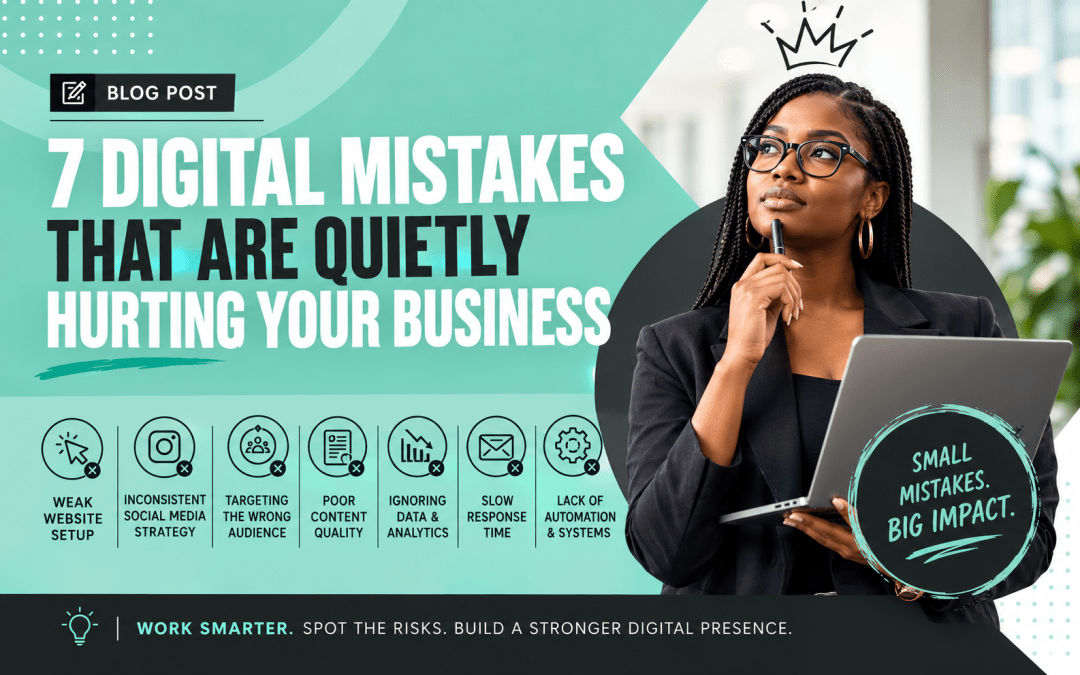
Here are seven common digital mistakes to avoid.
1. Your Business Is Online, But Your Customers Still Can’t Find You

As simple as it sounds, many businesses claim to be on LinkedIn, Instagram, Facebook, or other platforms, yet they are surprisingly difficult to find.
And when you eventually find them, their profiles are often poorly written. Their information is unclear, their services are not properly presented, and they have not clearly defined what they want their audience or potential customers to see.
The result? Your business can be online while your customers still struggle to find you.
The first step to solving this is identifying where your customers actually interact with your business.
In marketing, these points of interaction are called customer touchpoints. They can include WhatsApp, your website, social media platforms, search engines, online forums, and other digital channels.
Customers may encounter your business through several touchpoints. Once you identify these platforms, make sure each one has a clear, professional, and consistent profile. Every touchpoint should help customers:
- Find your business,
- Understand what you offer
- Trust your brand
- Connect with you
- See how your product or service can meet their needs
Being online is not enough. You need to be discoverable
2. If Your Website Doesn’t Convert Visitors Into Customers, It’s Just an Online Brochure

A beautiful website is great, but if it isn’t helping you generate enquiries, leads, or sales, you need to ask why.
Review the entire customer journey — from the moment visitors arrive on your website to the moment they leave. Where do they lose interest? Where do they get confused? What might be stopping them from taking the next step?
The problem could be:
- Unclear content
- Poor website design
- Weak calls to action
- Difficult navigation
- Lack of credibility
- Poor presentation of your products or services
- A complicated buying or enquiry process
Take the time to identify exactly why your website isn’t converting.
A website that simply sits there looking nice isn’t doing its job.
Your website should do more than tell people that your business exists. It should guide visitors toward taking action.
3. Posting Without Defining Your Buyer Persona

Many brands create social media pages without first defining who they are actually talking to.
From the moment you create a page for your brand, you need to have a clear understanding of who you are targeting.
Without a defined audience, anyone can follow your page, but they may not be the right people.
This is why some brands have 15,000 or even 30,000 followers, yet their posts receive very little meaningful engagement. A large following does not necessarily mean you have the right audience.
Some followers may be friends supporting the brand, inactive users, or people who simply have no real interest in what you sell.
If you want to get it right from the beginning, be clear about what you are selling and, more importantly, who you are selling it to.
Consider:
- What age group are they in?
- Where are they located?
- What problems do they have?
- What motivates them?
- How do they make purchasing decisions?
- Where do they spend their time online?
Once you define your buyer persona, it becomes much easier to create relevant content and run targeted campaigns that attract people who are genuinely interested in your product or service.
Don’t just build an audience. Build the right audience.
4. Your Content Talks About You Instead of Your Customers
You also need to be clear about your content strategy.
What do you want people to feel when they see your content?
What do you want them to understand?
What do you want them to perceive about your brand?
And most importantly, what do you want them to do?
Answering these questions helps define your strategy and gives you direction on what to post, when to post, and how to communicate.
One common mistake is creating content that talks too much about the brand and not enough about the customer.
For example, if you sell a product that solves a particular health or lifestyle problem, your content should connect that product to the problem your customer is experiencing, not simply talk about how great your brand is.
I usually tell people that if they want results online, they should follow a simple path:
“Problem → Solution → Sales”
Identify the problem your customers are trying to solve. Create or present a solution. Then make it easy for them to take the next step.
Don’t constantly say, “We are doing this. We are doing that. Our brand is the best.”
Instead, ask:
What problem does my customer have, and how can my business help solve it?
5. Boosting Posts Instead of Running a Proper Campaign

When I came into this space after my training in 2018, around the time Facebook was still relatively new to many business owners, I noticed that many people were busy boosting posts instead of running proper advertising campaigns.
Boosting a post can have its place, but it shouldn’t automatically be your entire advertising strategy.
If you’re serious about running digital advertising, go to Ads Manager and build a campaign around a specific objective.
And remember your buyer persona.
Know exactly who you’re running the campaign for:
- Where are they located?
- What is their age range?
- What are their interests?
- What do they do?
- What are their behavioural patterns?
- What action do you want them to take?
- When you enter Ads Manager with this level of clarity, you can segment your audience more effectively and build a campaign around a specific business goal instead of spending money simply to boost a random post.
Don’t just pay for visibility. Build campaigns with purpose.
6. Your Brand Looks Different Across Platforms

Your brand needs consistency.
From Facebook to Instagram, LinkedIn, X, your website, and even WhatsApp, your business should feel like the same brand.
Your visual identity, messaging, tone, and overall presentation should work together across platforms.
Don’t sell sugar on one platform and tea on another. There has to be harmony in how your brand looks, sounds, and shows up everywhere.
Consistency helps people recognise your business and builds familiarity over time.
Your customers should not have to wonder whether they’re looking at the same company when they move from your Instagram page to your website.
Your brand should be recognisable wherever people encounter it.
7. You Are Not Measuring What Is Actually Working
Finally, if you are not measuring your results, you’re flying blind.
Let me share a simple example from my own experience.
We noticed that a significant portion of our sales came through referrals. Because we measured where our customers were coming from, we knew that referrals were an important driver of our growth.
That information helped us understand where to focus our efforts instead of simply running campaign after campaign without knowing what was actually producing results.
This is where measurement becomes important.
You need to know:
- Are your ads generating customers?
- Are people finding you through Google?
- Are referrals driving sales?
- Is social media generating enquiries?
- Which content is getting meaningful engagement?
- Which activities are actually contributing to revenue?
Measure what matters.
Once you know what is working, you can invest more time and resources into it instead of guessing.
The Bottom Line
Your digital presence should not simply make your business visible.
It should help your business become discoverable, trusted, and profitable.
If you recognise your business in any of these seven mistakes, don’t be discouraged. Start correcting them one at a time.
Because digital growth isn’t just about being online.
It’s about using the online space strategically to move your business from where it is today to where you want it to be.